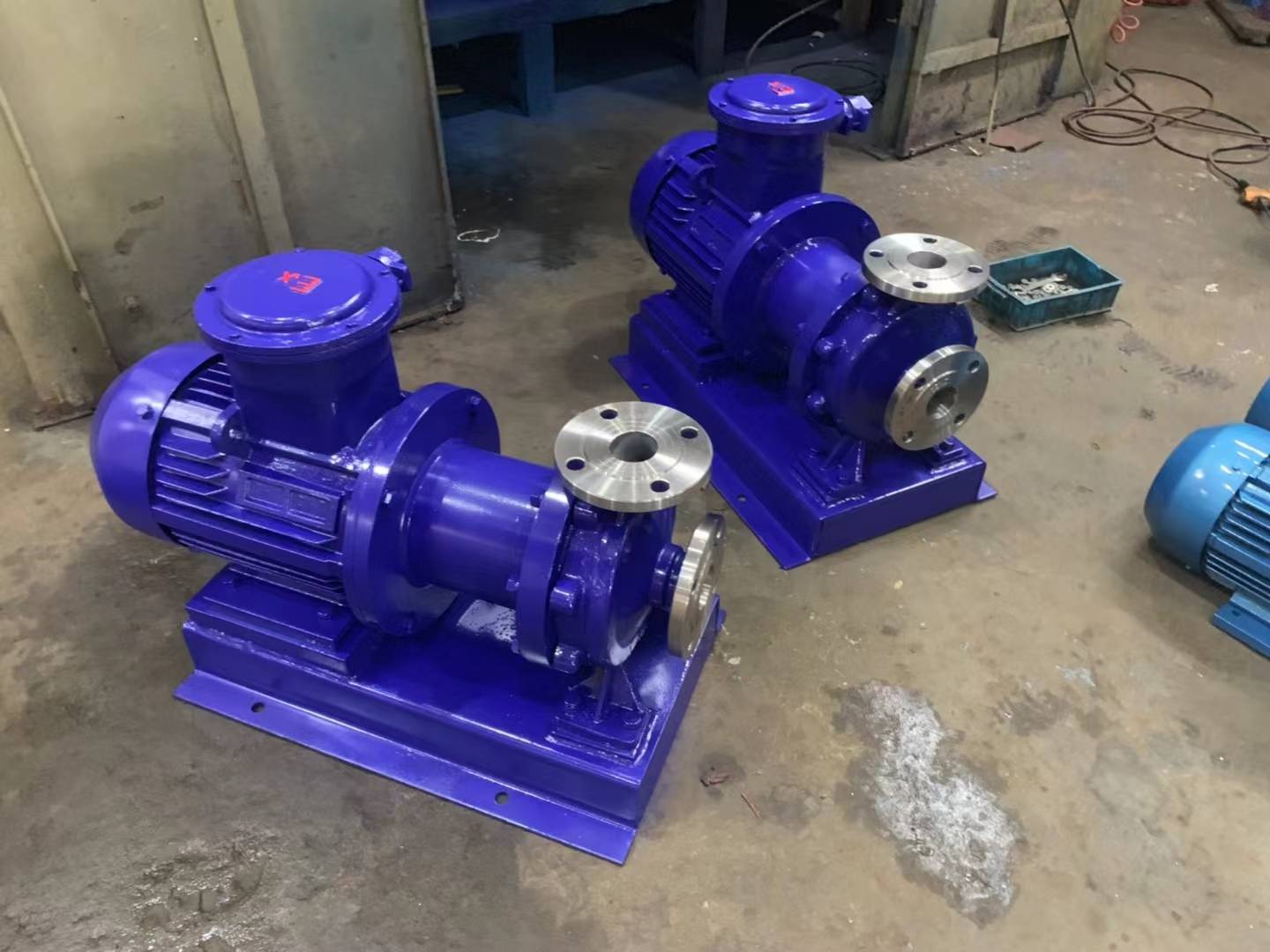
High-temperature magnetic drive pumps are compact, aesthetically pleasing, small in size, and feature stable, user-friendly operation with low noise levels. They are widely used in chemical, pharmaceutical, petroleum, electroplating, food, film processing, scientific research institutions, defense industries, and other sectors for pumping acids, alkaline solutions, oils, rare and valuable liquids, toxic liquids, volatile liquids, and in circulating water equipment, as well as for supporting high-speed machinery. They are particularly suitable for liquids that are prone to leakage, evaporation, combustion, or explosion. It is best to choose an explosion-proof motor for such pumps.
Advantages of High-Temperature Magnetic Drive Pumps:
1. No need to install a foot valve or prime the pump.
2. The pump shaft is changed from dynamic sealing to enclosed static sealing, completely avoiding media leakage.
3. No independent lubrication or cooling water is required, reducing energy consumption.
4. Power transmission is changed from coupling drive to synchronous dragging, eliminating contact and friction. This results in low power consumption, high efficiency, and provides damping and vibration reduction, minimizing the impact of motor vibration on the pump and pump cavitation vibration on the motor.
5. In case of overload, the inner and outer magnetic rotors slip relative to each other, protecting the motor and pump.
6. If the driven component of the magnetic drive operates under overload conditions or the rotor jams, the driving and driven components of the magnetic drive will automatically slip, protecting the pump. Under these conditions, the permanent magnets in the magnetic drive will experience eddy current losses and magnetic losses due to the alternating magnetic field of the driving rotor, causing the temperature of the permanent magnets to rise and leading to the failure of the magnetic drive slip.
Precautions for Using High-Temperature Magnetic Drive Pumps:
1. Prevent Particle Entry
(1) Do not allow ferromagnetic impurities or particles to enter the magnetic drive or the bearing friction pair.
(2) After transporting media prone to crystallization or sedimentation, flush promptly (fill the pump cavity with clean water after stopping the pump, run for 1 minute, then drain completely) to ensure the service life of the sliding bearings.
(3) When pumping media containing solid particles, install a filter at the pump inlet.
2. Prevent Demagnetization
(1) The magnetic torque must not be designed too small.
(2) Operate within the specified temperature conditions; strictly avoid exceeding the maximum allowable media temperature. A platinum resistance temperature sensor can be installed on the outer surface of the isolation sleeve to monitor the temperature rise in the gap area, enabling an alarm or shutdown if the temperature limit is exceeded.
3. Prevent Dry Running
(1) Strictly prohibit dry running (operating without liquid).
(2) Strictly avoid running the pump dry or allowing the media to be completely drained (cavitation).
(3) Do not operate the pump continuously for more than 2 minutes with the discharge valve closed, to prevent overheating and failure of the magnetic drive.
4. Not for Use in Pressurized Systems:
Due to the existence of certain clearances in the pump cavity and the use of "static bearings," this series of pumps must absolutely not be used in pressurized systems (neither positive pressure nor vacuum/negative pressure is acceptable).
5. Timely Cleaning:
For media that are prone to sedimentation or crystallization, clean the pump promptly after use and drain any residual liquid from the pump.
6. Regular Inspection:
After 1000 hours of normal operation, disassemble and inspect the wear of the bearings and the end face dynamic ring. Replace any worn-out vulnerable parts that are no longer suitable for use.
7. Inlet Filtration:
If the pumped medium contains solid particles, install a strainer at the pump inlet. If it contains ferromagnetic particles, a magnetic filter is required.
8. Operating Environment:
The ambient temperature during pump operation should be less than 40°C, and the motor temperature rise should not exceed 75°C.
9. Media and Temperature Limits:
The pumped medium and its temperature must be within the allowable range of the pump materials. For engineering plastic pumps, the temperature should be <60°C; for metal pumps, <100°C. The suction pressure should not exceed 0.2MPa, the maximum working pressure is 1.6MPa, for liquids with a density not greater than 1600 kg/m³ and a viscosity not greater than 30 x 10⁻⁶ m²/s, and which do not contain hard particles or fibers.
High-temperature magnetic drive pumps replace dynamic seals with static seals, making the pump's wetted parts fully enclosed. This solves the unavoidable running, dripping, and leaking issues associated with the mechanical seals of other pumps. Manufactured using highly corrosion-resistant materials such as engineering plastics, alumina ceramics, and stainless steel, these pumps offer excellent corrosion resistance and ensure the pumped media remains uncontaminated.